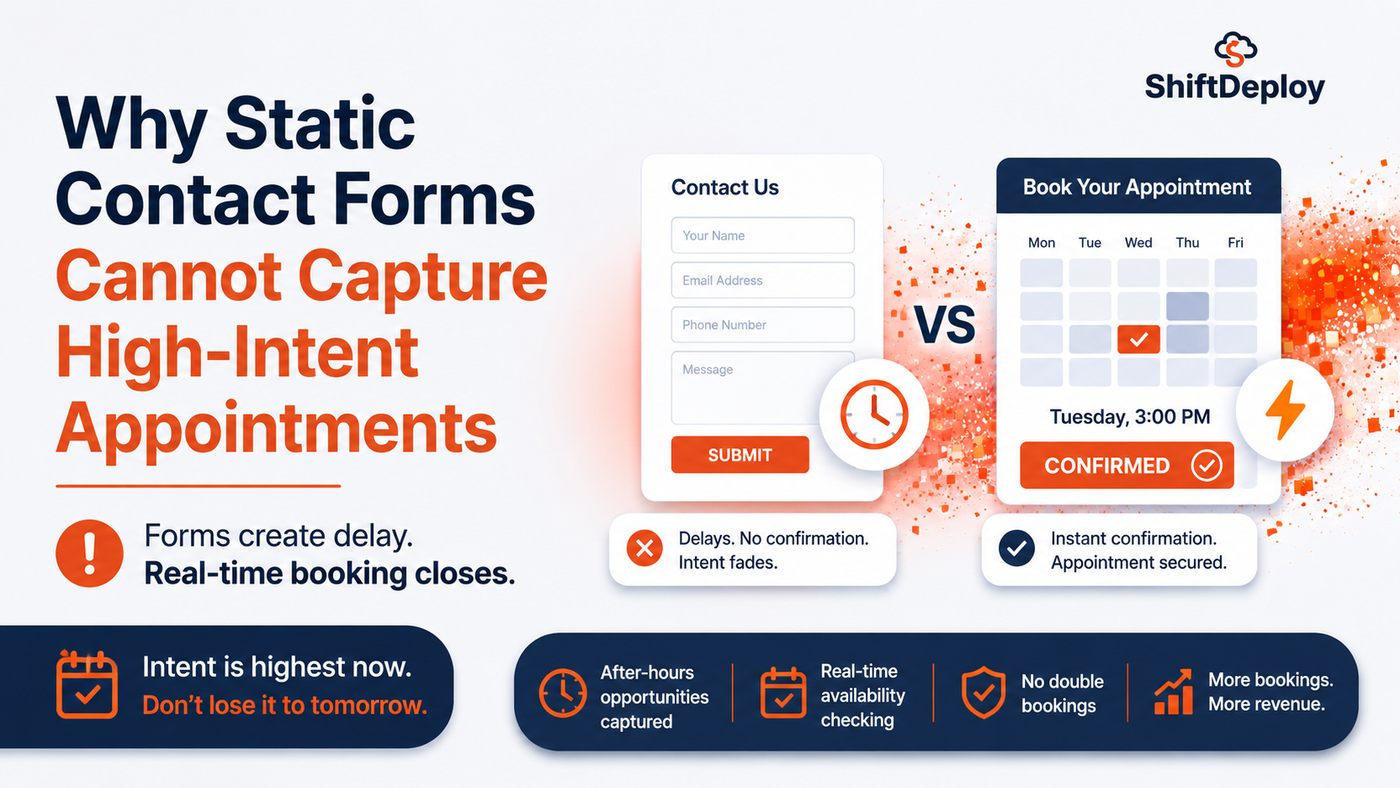
A static contact form sits between a patient's decision and your calendar with no logic layer connecting the two. It has no awareness of your available slots, no ability to prevent a double booking, and no mechanism to confirm anything in real time. For a general inquiry, that architecture is acceptable. For a high-ticket appointment booking at a dental clinic, med spa, or law firm, it is a structural failure dressed as a functional feature.
Only 9.09% of users who encounter a contact form actually submit it Form QR Code Builder, according to Zuko Analytics data across thousands of forms. That figure applies to all contact forms. On a high-ticket service booking page, where the intent is specific and the decision is already partially made, that number represents something more precise: a majority of ready-to-book patients leaving without a confirmed appointment, because the form gave them nothing to confirm against.
This is not a design problem. It is an architecture problem.
What a Static Form Is Actually Built to Do
A static HTML form with a POST action is a message relay. It accepts input, packages it into a submission, and delivers it to an inbox or a CRM record. That is its complete functional scope.
It does not check whether Tuesday at 3pm is available. It does not know that your last afternoon slot on Thursday was taken 4 minutes ago by a phone booking. It does not understand the difference between a $400 consultation request and a general inquiry from someone researching pricing. It accepts everything equally and resolves nothing autonomously.
The form was designed to capture an expression of interest. The business then separately resolves that expression into a confirmed appointment, through a human, through a phone call, through a follow-up email chain. That resolution process is where the revenue loss lives.
The Response Time Problem Is Not Small
Leads contacted within 5 minutes are 10 times more likely to convert than those contacted later, yet the average medical practice response time sits at 47 hours. Influx MD
Read that again. The average response time in the industry you are competing in is 47 hours. A patient who submits a booking request at 9:47pm on a Tuesday is statistically likely to receive a response sometime Thursday morning. The intent that produced that 9:47pm submission was at its peak in that moment. It is not paused for 47 hours. It decays.
Peak booking times for med spas are Tuesday 8 to 10 PM and Sunday 4 to 6 PM. Workee These are not edge cases. They are the primary windows in which your highest-intent patients have the time and space to research, compare, and commit. A static form with a next-business-day response is architecturally absent during the intervals that matter most.
The request chain for a form-based booking looks like this:
- Patient submits form at 9:47pm
- Form email arrives in shared inbox
- Staff sees it at 8:30am the next morning
- Staff calls the patient, reaches voicemail
- Patient calls back during their lunch break
- A confirmation is eventually reached, 18-24 hours after original intent
During that interval, your competitor whose system confirmed at 9:49pm has already scheduled the appointment.
The Conversion Gap in Numbers
Letting patients book immediately after form submission doubles inbound conversion rate, moving it from 30% to 66.7% on average. Chili Piper That data comes from analysis of 4 million form submissions. The variable is not messaging, not pricing, not marketing spend. It is whether the booking is resolved at the moment of intent or deferred to the next available human.
For a med spa running 120 monthly booking requests at an average ticket of $420, the arithmetic is direct:
- At 30% form-to-confirmed conversion: 36 appointments, $15,120/month
- At 66.7% conversion with immediate booking resolution: 80 appointments, $33,600/month
- Recoverable revenue from architecture change alone: $18,480/month, $221,760/year
That figure does not require more traffic, more advertising spend, or new services. It requires a different architecture for resolving the requests you are already receiving.
Up to 40% of new client leads drop off during a high-friction booking flow. Workee The friction is not always visible in your analytics. It does not always produce a bounce event. Sometimes it produces a session that ended at the form page without a submission. Sometimes it produces a submission that was never followed up within the patient's intent window. In both cases, the patient is absent from your CRM, and the absence looks like normal volume.
What the Architecture Is Actually Missing
A static form has no connection to your calendar. This is the technical fact that explains every downstream failure.
It cannot check available slots because it has no API call to your calendar object. It cannot prevent double bookings because it does not know what is already booked. It cannot route a high-value consultation request to a priority slot because it has no awareness of slot categories. It cannot confirm in real time because confirmation requires writing to a calendar state it cannot access.
The request chain requires a human at every decision point, because the form has no decision logic. The human is the intelligence layer between the form submission and the calendar. When the human is unavailable, after hours, on a call, or managing three other simultaneous tasks, the intelligence layer is simply absent.
The Patients Not in Your CRM
The most consequential revenue loss from a static form does not appear in your reporting. It is not the submission that went unanswered. It is the patient who encountered the form, evaluated the friction, and did not submit at all.
More than 67% of site visitors will abandon a form permanently if they encounter any complications. WPForms On a booking form for a high-ticket service, "complications" include: not knowing whether a preferred time is available, not receiving any immediate acknowledgment, being asked for information the patient cannot provide without speaking to someone first, and encountering a form that provides no confirmation that anything will actually be scheduled.
These patients are not in your bounce rate as a clearly identifiable segment. They are in your normal session data as users who visited the booking page and left. Your analytics interprets their departure as changed intent. In a meaningful proportion of cases, it was changed expectation. They arrived ready to book and encountered an interface that could not resolve that readiness into a confirmed appointment.
The form was never designed to close a sale. It was designed to receive an inquiry. Those are different objects, and treating one as the other has a specific, calculable cost.
Key Diagnostic Questions for Practice Owners
Before diagnosing your booking infrastructure as a marketing problem or a traffic problem, these questions isolate where the actual failure is occurring:
- What is the average time between form submission and your first human contact with the patient?
- What percentage of your form submissions arrive between 7pm and 8am?
- What is your current form-to-confirmed-appointment conversion rate, not your form-to-submission rate?
- How many submissions per month receive no follow-up within 24 hours?
- What is the stated reason for slots going unfilled when a waitlist exists?
Each of these questions has an answer that points to either an architecture problem or a genuine demand problem. Most practices, when they measure these inputs for the first time, discover the former.
Conclusion
The static contact form has one structural limitation that no design change, copy optimization, or marketing campaign can overcome: it cannot resolve a patient's booking intent in real time, because it has no connection to the calendar state that would allow it to do so.
The appointment booking system you need is not a better form. It is a different architecture entirely, one that checks availability at write time, confirms in under 90 seconds, operates at any hour, and eliminates the human dependency that makes every overnight and weekend request a missed opportunity.
The gap between what a static form does and what a booking system does is not measured in features. It is measured in the appointments that never made it to your calendar.

ShiftDeploy Technical Team
ShiftDeploy Team