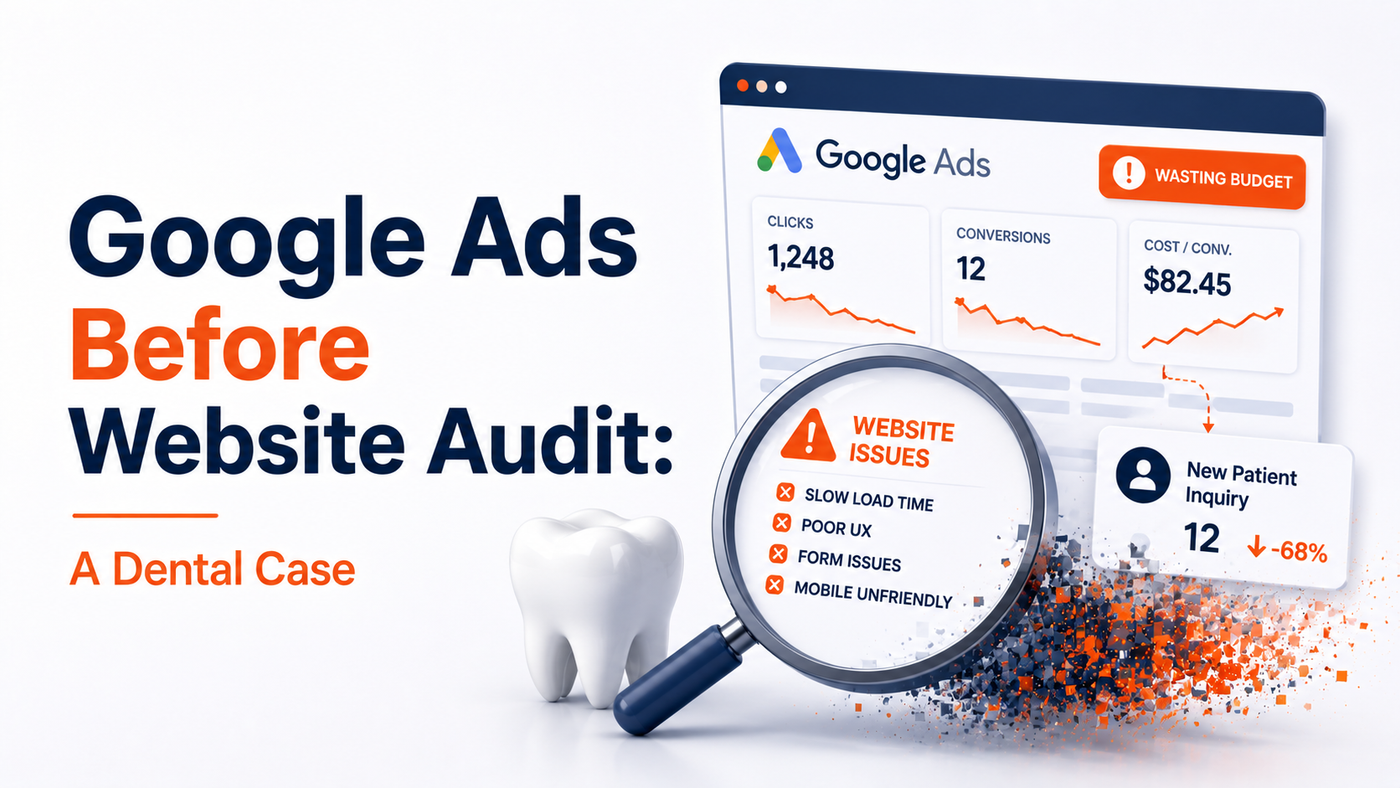
Diagnostic Memo: Why We Paused a Google Ads Request
Running Google Ads before auditing landing page performance is one of the more consistent patterns we observe in service businesses that report poor return on ad spend. The traffic arrives. The page fails to convert it. The conclusion drawn is that the ads are underperforming, when the actual constraint is infrastructure.
This memo documents a specific engagement: a dental clinic founder who approached us for Google Ads support. What we found during the pre-campaign audit changed the priority sequence before any budget was committed.
The Initial Request: Paid Traffic for a Dental Landing Page
During a routine performance scan of dental clinic websites in our region, we identified a single-page site failing Google's Core Web Vitals assessment. We sent the founder a light technical summary of the findings.
His response was prompt and unambiguous:
"Hey, thank you for reaching out. I am looking for One-time Google-Ads service."
He was not looking for a technical audit. He was looking for traffic. Specifically, a paid campaign to direct potential patients to the landing page in question.
ShiftDeploy does not offer ad management services. More relevantly for this engagement: we do not recommend directing paid traffic to a landing page that has not been audited for conversion readiness. The cost of doing so is predictable and measurable.
We scheduled a call to discuss the diagnostic findings before any campaign discussion.
The Pre-Campaign Landing Page Audit: Two Critical Friction Points
Before the call, we completed a full performance audit of the single-page site. The format is worth noting: a single-page design places the entire conversion burden on one URL. There are no secondary pages to recover a lost user. Every friction point has a direct and unmitigated cost.
We identified two issues with immediate revenue implications:
Friction Point 1: Mobile Navigation Blocking the Conversion Action
Type: UX / Mobile Interaction Defect
On mobile, the sticky navigation bar occupied approximately 30% of the visible screen area. The defect was in its behaviour after a user tapped a section link.
| User Action | Expected Behaviour | Actual Behaviour |
|---|---|---|
| Taps 'Services' in navbar | Taps 'Contact' in navbar | Attempts to read or click CTA |
| Scrolls to Services section; menu closes | Scrolls to Contact section; menu closes | Full CTA visible and accessible |
| Scrolls to section; menu remains open | Scrolls to section; menu blocks headline and CTA | CTA partially or fully hidden behind navbar |
To access the content or CTA after tapping any navigation link, the user was required to manually locate and tap the close icon. This added a non-trivial interaction step on every section visit, on a single-page site where users are expected to scroll through multiple sections before booking.
In a paid campaign context, this interaction overhead is a conversion tax on every click purchased. Mobile users navigating under time pressure, the typical profile for a patient searching for a dental appointment will not resolve unexpected UI friction. They will leave.
Friction Point 2: Core Web Vitals Failure on LCP
Type: Performance / Mobile Load Speed
The page was failing Google's Largest Contentful Paint (LCP) threshold. The primary cause was an unoptimised hero image high resolution, uncompressed, served at desktop dimensions to mobile devices.
| Metric | Measured Value | Google Threshold (Good) | Status |
|---|---|---|---|
| LCP (mobile) | 4.8 seconds | < 2.5 seconds | Poor |
| Hero image file size | 3.2 MB | < 200 KB recommended | Fail |
| Mobile PageSpeed Score | 34 / 100 | 75+ recommended | Poor |
| CWV Assessment | Failed | Pass required | Fail |
A failed Core Web Vitals assessment has two direct consequences for a Google Ads campaign. First, Google's Ad Quality Score incorporates landing page experience, poor CWV scores increase cost-per-click and reduce ad placement frequency. Second, a 4.8-second LCP will produce measurable abandonment before the page content is visible, independent of ad quality.
Benchmark Reference Google Ads Quality Score includes landing page experience as a factor. Pages with poor Core Web Vitals scores typically receive lower Quality Scores, increasing effective CPC. Google Mobile Speed Study: 53% of mobile visits are abandoned at load times above 3 seconds. At 4.8 seconds LCP, a substantial proportion of paid clicks would not result in a visible page.
→ See also: [Dental Clinic Website Performance — ShiftDeploy Niche Services]
The Consultation: Reframing the Priority Sequence
On the call, we shared the audit findings directly, screen-sharing the mobile navigation issue and walking through the LCP data. The goal was not to redirect the engagement toward a different service. It was to clarify what the ad budget would actually purchase in current conditions.
The framing we used:
"If you run Google Ads right now, you are paying for users to land on a page that fights them. The traffic will arrive. A measurable portion will leave before the page loads. Of those who stay, a further proportion will leave due to the navigation issue before reaching the booking form. You are not buying conversions, you are buying visits to a page that is not ready to convert them."
This is the core relationship: marketing delivers traffic; engineering determines what happens to it. When the infrastructure has unresolved friction, ad spend accelerates loss rather than growth.
The founder's immediate priority shifted from campaign launch to infrastructure resolution.
Diagnostic Boundary: When Running Ads Before an Audit Is Acceptable
The recommendation to audit before running paid traffic is not universal. There are conditions under which a campaign can proceed without a full pre-launch technical audit.
Proceeding Without a Full Audit Is Reasonable When:
- Mobile LCP is under 2.5 seconds on a real device test (WebPageTest, 4G throttling) and PageSpeed Insights mobile score is above 75.
- Core Web Vitals field data in Google Search Console shows 'Good' status on the target landing page URL.
- A previous audit has been completed within 90 days and no significant site changes have been made since.
- The campaign is a low-budget test (under £500 total) being run specifically to gather conversion data on a known-functional page.
An Audit Before Running Ads Is Warranted When:
- CWV assessment status is 'Failed' or 'Needs Improvement' on the target landing page.
- Mobile PageSpeed Insights score is below 60.
- The site has not been audited in the past six months and has undergone design, plugin, or content changes.
- Mobile and desktop conversion rates from organic traffic are materially divergent (more than 15 percentage points).
- The site is a single-page design where all conversion actions occur on one URL, friction points have no recovery mechanism.
The cost of a pre-campaign audit is fixed. The cost of running traffic to an unconverted page compounds with every click purchased. In most cases, the audit pays for itself within the first month of ad spend it prevents from being wasted.
→ See also: Why Static Contact Forms Cannot Capture High-Intent Appointments
Resolution: Infrastructure Stabilised, Site Ready for Traffic
We provided a technical roadmap addressing both friction points. The founder prioritised implementation over the following four weeks.
| Issue | Fix Applied | Outcome |
|---|---|---|
| Sticky navbar not closing on section tap | JavaScript interaction handler updated; menu auto-closes on link tap | Navigation behaves correctly on all tested mobile devices |
| Hero image uncompressed (3.2 MB) | Converted to WebP; resized to mobile viewport; lazy loading applied | File size reduced to 180 KB |
| LCP 4.8 seconds (mobile) | Image optimisation + script deferral | LCP reduced to 2.2 seconds |
| CWV Assessment: Failed | Combined image and script fixes | CWV Assessment: Passed |
One month after implementation, a follow-up scan confirmed stable infrastructure. The mobile navigation operates correctly. Core Web Vitals are within the green threshold. The site now meets the technical baseline for a paid traffic campaign to have a reasonable probability of converting.
The distinction is worth stating plainly: the site was not redesigned. The brand, copy, and offer were unchanged. Two engineering fixes converted a liability into a functional conversion asset.
Conclusion: Audit Landing Page Performance Before Committing Ad Budget
The pattern in this engagement is not unusual. Business owners allocate ad budget in the expectation that traffic volume is the constraint — that more visitors will produce more appointments. When the landing page has unresolved friction, that assumption does not hold.
Paid traffic amplifies whatever a page does with visitors. If the page converts well, ad spend accelerates growth. If the page has friction points that cause abandonment, ad spend accelerates loss.
The ShiftDeploy position: marketing promises traffic; engineering ensures revenue. A pre-campaign landing page audit is not a delay to running ads — it is the precondition for ads to perform.
If you are planning a paid campaign: run a Core Web Vitals check on your landing page before committing budget.
Free audit
Get your free auditAuthored by the Technical Team at ShiftDeploy.
We help service businesses identify and resolve web performance constraints that affect revenue from paid and organic traffic.
Tags: #GoogleAds #LandingPagePerformance #CoreWebVitals #DentalMarketing #AdSpendReadiness #CRO #ShiftDeploy
ShiftDeploy Technical Team
ShiftDeploy Team